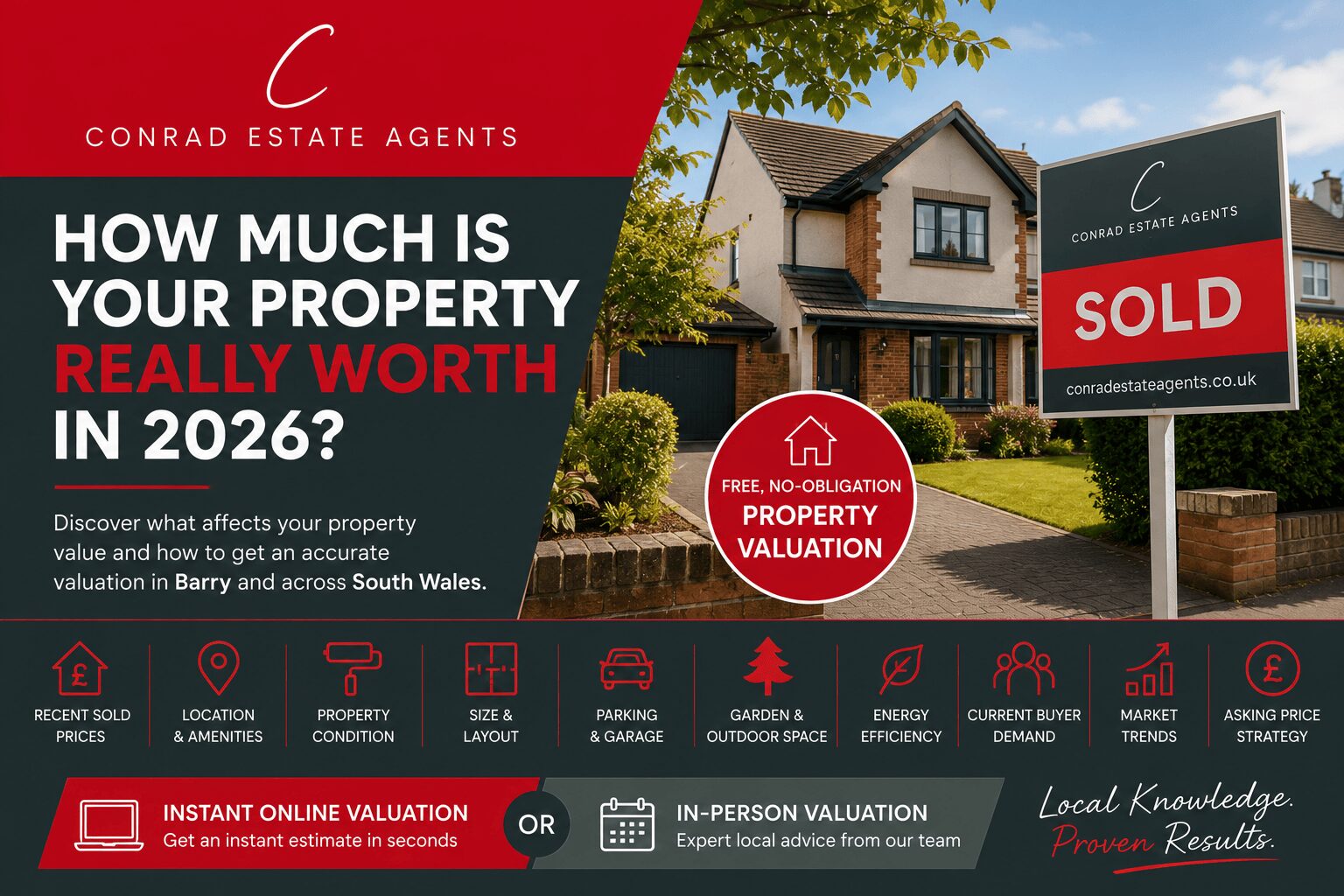
For most homeowners, their property is their biggest financial asset.
Whether you’re thinking about selling, remortgaging, relocating or simply curious about how the market has changed, one question naturally comes to mind:
How much is my property actually worth?
With online valuation tools, property portals and house price data now readily available, it’s easier than ever to get an estimate. However, establishing what a buyer would genuinely pay for your home is more complicated than looking at an average price for your postcode.
At Conrad Estate Agents, we value properties across Barry, the Vale of Glamorgan, and South Wales, and we consider several important factors when determining a realistic market value.
1. Recent Sold Prices
One of the best starting points when valuing a property is looking at what comparable homes have actually sold for.
The important word here is sold.
A property being advertised for £300,000 doesn’t necessarily mean it’s worth £300,000. It could eventually sell for £280,000, be reduced several times or even be withdrawn from the market.
An accurate valuation considers comparable properties that have successfully sold, as well as those currently competing for buyers.
We look at factors including:
- Property type
- Number of bedrooms
- Floor area
- Condition
- Location
- Parking
- Garden
- Extensions and improvements
- Recent comparable sales
Sometimes two houses on the same street can have significantly different values.
2. Location – Even Within the Same Postcode
We’ve all heard the phrase location, location, location, and it remains one of the biggest influences on property value.
But location isn’t simply about the town.
Two properties less than half a mile apart can command different prices because of:
- School catchment areas
- Transport links
- Parking
- Sea or countryside views
- Proximity to shops and amenities
- Road position
- Noise
- Nearby development
- The desirability of an individual street
This is one reason automated valuations can struggle.
An algorithm may understand that two houses are geographically close, but an experienced local estate agent understands why buyers might pay considerably more to live on one particular road.
3. The Condition of Your Property
Condition can have a substantial impact on both value and saleability.
A beautifully presented, ready-to-move-into property may attract buyers willing to pay a premium for convenience.
At the other end of the market, properties requiring significant refurbishment can also attract strong interest from investors and buyers looking for a project. But the price needs to reflect the work required.
It’s important to distinguish between value and saleability.
Spending £20,000 improving your home doesn’t automatically increase its value by £20,000.
Some improvements add considerably more value than others.
4. Extensions and Additional Space
Additional usable living space can significantly increase a property’s appeal.
This might include:
- Loft conversions
- Rear extensions
- Conservatories
- Garage conversions
- Additional bedrooms
- Home offices
- Utility rooms
However, the quality and usefulness of the additional space matters.
A professionally completed extension that creates a large kitchen/family room may have a very different impact from a poorly configured addition that compromises the garden or layout.
5. Parking and Garages
Parking can make a considerable difference, particularly in areas where on-street parking is limited.
Off-road parking, driveways and garages can all increase buyer interest.
The importance varies depending on location. A driveway may be expected in some suburban developments but command a significant premium on streets where parking is particularly difficult.
Again, this is where understanding the micro-market becomes important.
6. Gardens and Outside Space
Since the pandemic, many buyers continue to place considerable importance on outdoor space.
The size, orientation and usability of a garden can all affect desirability.
A south-facing garden is often attractive, but buyers also consider:
- Privacy
- Maintenance
- Patio or entertaining areas
- Access
- Overall size
- Views
A smaller, well-designed garden can sometimes be more appealing than a much larger garden requiring extensive maintenance.
7. Energy Efficiency
Energy efficiency has become increasingly important as buyers consider the ongoing costs of homeownership.
Features such as:
- Modern boilers
- Double glazing
- Improved insulation
- Solar panels
- Heat pumps
- Modern heating controls
can all contribute to a property’s appeal.
An Energy Performance Certificate (EPC) also allows buyers to compare the expected efficiency of different homes.
Although an improved EPC rating doesn’t automatically translate into a specific increase in value, running costs are increasingly a factor in the buying decision.
8. Current Buyer Demand
Property values aren’t fixed.
Ultimately, a property is worth what a willing buyer is prepared to pay in the current market.
If several buyers compete for a limited number of properties, prices can rise.
If buyers have a large amount of choice, sellers may need to become more competitive.
That’s why a valuation completed two years ago – or even six months ago – shouldn’t automatically be relied upon today.
The market changes.
9. Why Online Property Valuations Can Differ
Online valuations can be extremely useful as a starting point.
They typically analyse information such as:
- Previous sold prices
- Local price trends
- Property type
- Number of bedrooms
- Available property data
However, they can’t always see what’s happened inside your home.
An online system may not know you’ve spent £60,000 extending and renovating the property.
Equally, it may not know that a property hasn’t been modernised for 30 years.
That’s why online valuations are best viewed as an initial estimate rather than a guaranteed selling price.
For a more accurate figure, the property itself needs to be taken into account.
10. Beware of the Highest Valuation
When choosing an estate agent, it’s naturally tempting to select whoever provides the highest valuation.
But the highest valuation isn’t necessarily the best valuation.
An unrealistic asking price can result in a property sitting on the market for months.
Eventually, sellers may have to reduce the price – by which point buyers have already seen the property repeatedly online.
A property that’s been available for a long time can lead buyers to wonder:
“What’s wrong with it?”
Launching at the right price can create far more momentum.
The first few weeks of marketing are particularly important because that’s when your property is new to the market and reaches the largest pool of existing buyers.
Asking Price vs Market Value
These two figures aren’t always the same.
The asking price is the figure at which your property is advertised.
The market value is what buyers are genuinely prepared to pay.
A good pricing strategy considers both.
Depending on the property and market conditions, an agent may recommend:
- A fixed asking price
- Offers over
- Offers in the region of
- A guide price
The objective isn’t necessarily to advertise at the highest possible number.
It’s to choose a price that generates enough interest to achieve the strongest possible final result.
What Is My House Worth in Barry?
Property values across Barry can vary substantially depending on the area and property type.
Barry Island, West End, Highlight Park, Pencoedtre Village, Barry Waterfront and the traditional streets surrounding the town centre all have their own individual markets.
Even within these areas, values can differ from street to street.
A three-bedroom semi-detached property with a driveway and large garden may appeal to a completely different buyer from a three-bedroom traditional terrace closer to the town centre.
That’s why local comparable evidence is so important.
Should I Get My Property Valued Even If I’m Not Ready to Sell?
Absolutely.
You don’t need to be putting your home on the market next week to arrange a valuation.
Understanding your current property value can help when:
- Planning your next move
- Calculating available equity
- Considering upsizing
- Considering downsizing
- Reviewing your mortgage
- Planning future investments
- Deciding whether home improvements are worthwhile
A valuation can simply give you a better understanding of your financial position.
Find Out What Your Property Is Worth
If you’re wondering “How much is my house worth?”, Conrad Estate Agents can help.
We’ll assess your property, examine recent comparable evidence and consider current buyer demand before providing an honest and realistic market valuation.
Whether you’re ready to sell immediately or simply planning for the future, there’s no obligation to proceed.
Contact Conrad Estate Agents today to arrange your free property valuation in Barry or across South Wales.