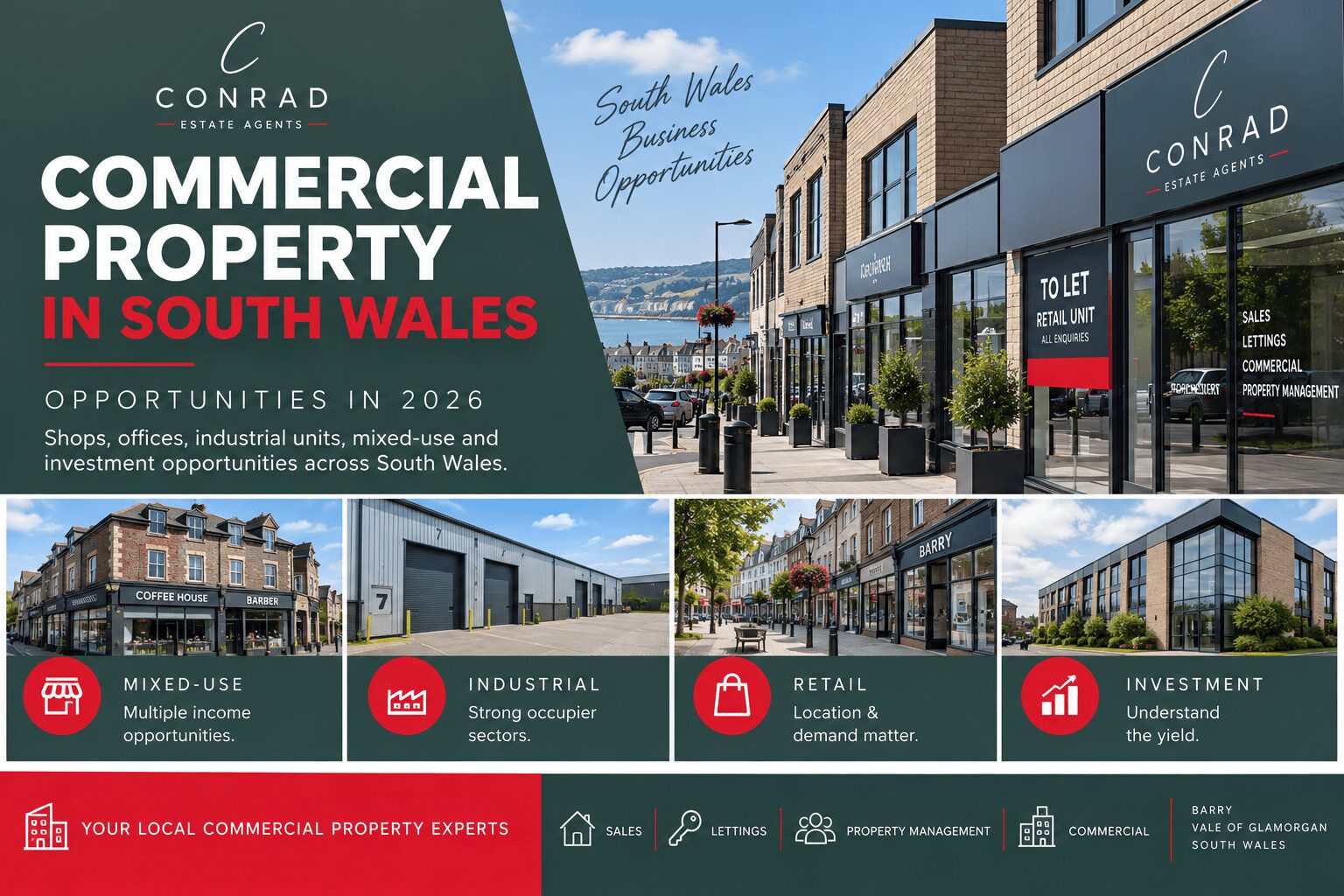
Commercial property in South Wales offers investors opportunities very different from traditional residential buy-to-let, from shops and mixed-use buildings to offices and industrial units.
Across South Wales, commercial property remains an interesting market in 2026.
Higher borrowing costs have put pressure on some investors, changing working habits continue to affect parts of the office sector, and the traditional high street continues to evolve. At the same time, these changes can create opportunities for investors who understand the property, the tenant and the location.
At Conrad Estate Agents, we work across residential and commercial property throughout Barry, the Vale of Glamorgan and South Wales. Here are some of the key areas we believe investors should consider when assessing a commercial property.
Commercial Property Is Not One Market
The term “commercial property” covers a huge range of investments.
A small retail unit in Barry town centre is fundamentally different from a warehouse on an industrial estate. Likewise, an office, restaurant, mixed-use building or large industrial unit will each have different tenants, risks and potential returns.
That means investors shouldn’t simply ask:
“Is commercial property a good investment?”
A better question is:
“Is this particular commercial property, at this price, with this tenant or potential use, a good investment?”
The numbers and fundamentals of the individual property matter far more than the label attached to it.
Why Commercial Property Can Be Attractive
One of the biggest attractions is potential rental yield.
Commercial properties can sometimes produce stronger yields than residential property, particularly in locations where purchase prices remain relatively affordable.
Lease structures can also be attractive.
Rather than the relatively frequent tenant turnover that can occur in residential lettings, a commercial tenant may sign a lease lasting several years.
That can potentially provide an investor with a more predictable income stream.
However, the trade-off is important.
When a residential property becomes vacant, there is generally a large pool of potential tenants.
Finding the right tenant for a specialist commercial building can take considerably longer.
Commercial investors therefore need to think about income during occupation and the potential cost of vacancy.
The Tenant Can Be Just as Important as the Building
A commercial investment isn’t simply a property investment.
In many cases, you’re also investing in the tenant’s ability to keep paying rent.
Imagine two identical commercial units producing £15,000 per year.
One has a financially established business with several years remaining on its lease.
The other has a newly established company with a short trading history.
The buildings may be identical, but an investor may value the income streams very differently.
This is why tenant covenant strength, lease length, break clauses, rent reviews and repairing obligations are important considerations when valuing commercial investments.
Vacant Commercial Property Can Create Opportunity
Not every commercial investment needs to have a tenant in place.
A vacant property can sometimes be purchased at an attractive price, particularly where the existing owner wants a quick disposal.
The investor may then have an opportunity to improve the property, secure a tenant and potentially increase its investment value.
However, vacant commercial property also introduces additional risk.
Until a tenant is secured, there is no rental income.
You may also face business rates, insurance, security, maintenance, and finance costs.
The potential upside therefore needs to justify the period during which the investor may be funding the property themselves.
Mixed-Use Property Can Be Particularly Interesting
Mixed-use buildings are common throughout South Wales.
A typical example might be a ground-floor shop with a residential flat above.
For some investors, these properties can be particularly attractive because income isn’t dependent entirely on one occupier or one part of the market.
For example, a property could potentially generate:
£600 per month from the commercial unit
and
£800 per month from the residential flat.
That would produce £1,400 per month or £16,800 per year before expenses.
The investor can then compare that income with the purchase price to calculate the property’s gross yield.
Mixed-use buildings can be more complicated to finance and manage than a standard residential investment, so you need to understand the property’s structure before purchasing.
Understanding Commercial Property Yield
Yield is one of the most common ways investors compare commercial properties.
A simple gross yield calculation is:
Annual Rent ÷ Purchase Price × 100
For example, if a property costs £200,000 and produces £16,000 per year:
£16,000 ÷ £200,000 × 100 = 8% gross yield.
But an 8% yield doesn’t automatically make something a good investment.
A higher yield can sometimes indicate higher risk.
Investors should also consider maintenance, insurance, management, finance, potential vacancy, lease terms and future capital expenditure.
A lower-yielding property with an excellent tenant on a strong lease could potentially be more attractive than a 10% yielding property where the tenant is likely to leave shortly.
Industrial Property Remains an Interesting Sector
Industrial and warehouse property has attracted considerable investor attention over recent years.
E-commerce, logistics, storage and changing supply chains have all increased the importance of industrial space.
For smaller investors, the opportunity doesn’t necessarily mean purchasing enormous distribution warehouses.
Small industrial units, workshops, trade counters and storage units can provide exposure to the sector at a much lower purchase price.
South Wales has a significant amount of industrial property across Cardiff, the Vale of Glamorgan, Bridgend, Newport and the surrounding valleys.
The key remains understanding local occupier demand.
A cheap industrial unit isn’t necessarily good value if few businesses want to occupy it.
What About Retail Property?
The retail sector has experienced enormous structural change.
Online shopping has reduced demand for certain traditional shops, while changing consumer behaviour has transformed many town centres.
But that doesn’t mean retail property is dead.
Successful high streets increasingly contain businesses that cannot simply be replicated online.
These can include cafés, restaurants, barbers, beauty businesses, professional services, convenience stores and specialist retailers.
The opportunity for investors can sometimes be buying smaller units at sensible prices where genuine local demand remains.
The important consideration is not simply how busy the high street looks.
It is whether businesses can trade profitably from the location and afford the rent required to make the investment work.
Offices Require More Careful Consideration
Hybrid and remote working have changed the office market.
Some businesses need less space than before, while others have moved toward smaller but higher-quality offices.
That doesn’t mean offices no longer have value.
It does mean investors need to be more selective.
Location, parking, transport connections, energy efficiency, internet connectivity, and space flexibility can all influence demand.
An office that suited businesses 20 years ago may require investment or repositioning to compete today.
Could Commercial Property Be Converted?
Another reason investors look at commercial buildings is the potential for alternative uses.
Subject to planning permission, building regulations and other requirements, some properties may potentially be converted or redeveloped.
This could include residential conversion, mixed-use redevelopment or subdivision into smaller commercial units.
However, investors should never purchase a property based purely on the assumption that permission will be granted.
The existing use needs to make sense as an investment unless you’ve properly investigated the alternative use.
Development potential should ideally represent upside rather than being the only reason the investment works.
Location Still Matters — But Differently
Commercial property location works differently from residential property.
A beautiful residential street doesn’t automatically make a good commercial location.
Different businesses need different things.
Retailers may want visibility and footfall.
Industrial occupiers may prioritise road access and loading facilities.
Offices may require parking and public transport.
Restaurants may value evening footfall and proximity to complementary businesses.
The right commercial property should match the type of occupier likely to use it.
Interest Rates Can Create Both Risk and Opportunity
Borrowing costs remain an important consideration for property investors in 2026.
Higher finance costs reduce the amount investors can afford to pay while maintaining their required return.
This can put downward pressure on commercial property values.
But that can also create opportunity.
An investor with sufficient capital may be able to purchase a property at a yield that would have been difficult to achieve during a period of extremely cheap borrowing.
The crucial calculation is whether the rental income comfortably supports the investment after finance and other costs.
Investors should stress-test the numbers rather than assuming refinancing will always become cheaper.
Don’t Ignore Energy Efficiency
Energy efficiency is increasingly important within commercial property.
Investors need to understand a building’s EPC rating, its running costs, and whether future improvements may be required.
An inefficient commercial property may require significant capital expenditure.
Conversely, improving an older building could potentially make it more attractive to tenants and protect its longer-term value.
This is another reason the cheapest property isn’t necessarily the best investment.
Commercial Property Requires Proper Due Diligence
Before purchasing, investors should understand considerably more than the asking price and current rent.
Important areas can include:
- Current lease and remaining term
- Tenant covenant
- Break clauses
- Rent review provisions
- Repairing obligations
- Service charges
- Business rates
- Insurance responsibilities
- EPC
- Planning and permitted use
- VAT position
- Title and access
- Development potential
- Local comparable rents
- Local occupier demand
Professional legal, financial, surveying and tax advice can therefore be particularly important with commercial transactions.
Is Commercial Property Worth Considering in 2026?
For the right investor, absolutely.
But commercial property shouldn’t simply be viewed as a higher-yield alternative to residential buy-to-let.
The risks are different.
A strong commercial investment can potentially provide attractive income, longer leases and less day-to-day involvement than some residential portfolios.
A poor commercial investment can sit empty for months while still generating costs.
We believe some of the most interesting opportunities across South Wales are likely to be properties with genuine occupier demand, sensible purchase pricing, and either high existing income or a clear route to creating it.
Mixed-use buildings and smaller commercial units can also provide an accessible route into the sector for investors who don’t want to commit to significantly larger commercial assets.
Ultimately, the same principle applies to commercial property as any other investment:
The purchase price matters, the income matters, and the underlying demand matters.
Buying, Selling or Letting Commercial Property in South Wales?
Conrad Estate Agents provides commercial property sales and lettings services across Barry, the Vale of Glamorgan and South Wales.
Whether you’re considering selling a commercial investment, looking for a tenant, assessing a mixed-use property or searching for your next investment opportunity, we can help assess the property’s local market position and potential.
Contact Conrad Estate Agents to discuss your commercial property requirements.
This article is provided for general information only and does not constitute financial, investment, legal or tax advice. Commercial property investors should obtain appropriate professional advice before making an investment decision.