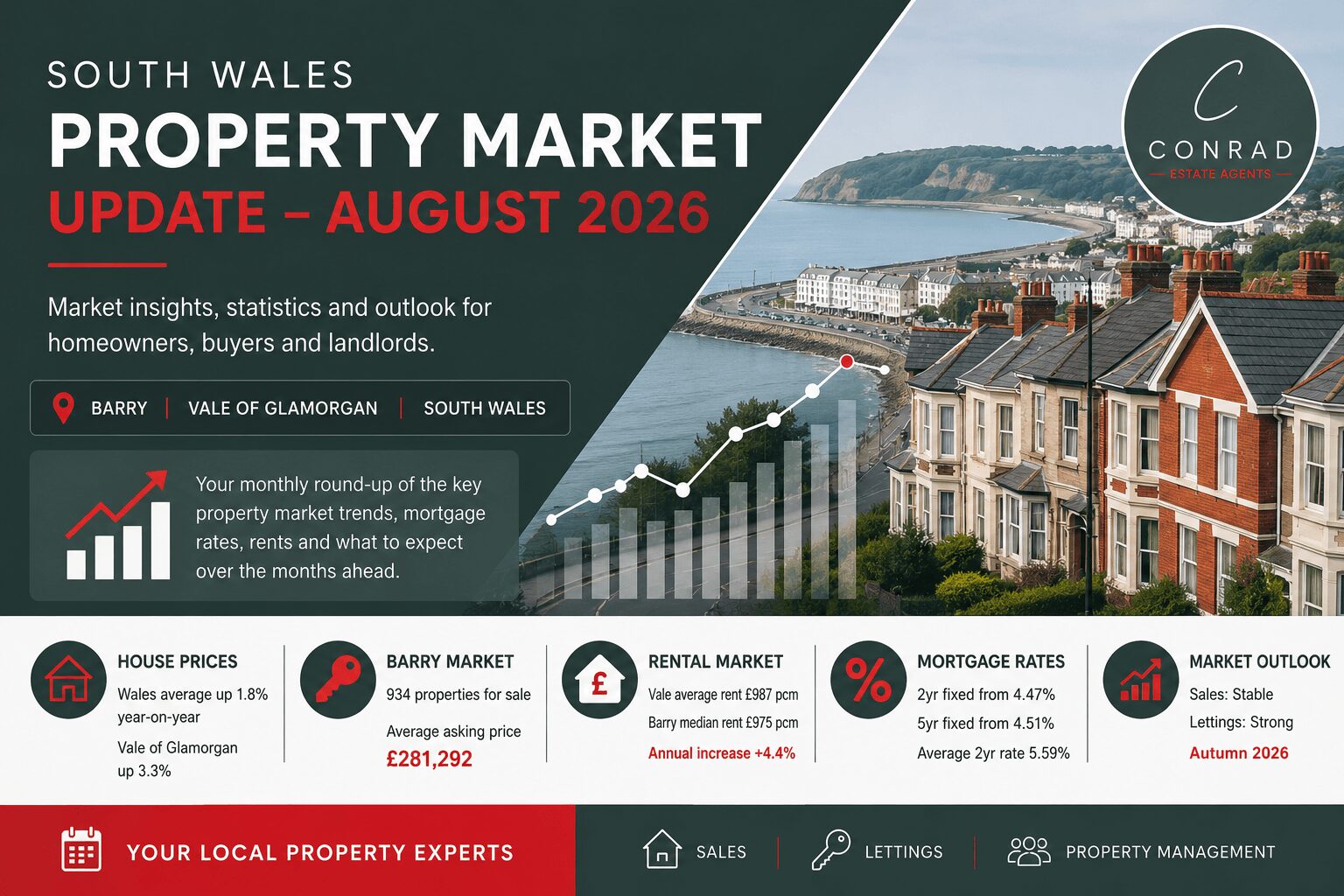
South Wales Property Market Update – August 2026
House Prices, Rents, Mortgage Rates & What Could Happen Next?
Our South Wales Property Market Update for August 2026 looks at the latest house prices, rental trends, mortgage rates and economic developments affecting homeowners, landlords and buyers across South Wales.
As we move into September 2026, the South Wales property market finds itself in an interesting position.
Property prices remain relatively resilient, rents continue to rise, and the Bank of England has kept the base rate at 3.75%. However, behind the headline figures, financial markets have become more volatile, with higher bond yields, energy prices and inflation concerns putting renewed pressure on mortgage pricing.
For homeowners, buyers, and landlords, this creates a market that is neither clearly booming nor in decline.
Instead, we are seeing a market increasingly driven by affordability, realistic pricing and individual property quality.
In our August 2026 property market update, Conrad Estate Agents looks at what is happening across the economy, the Welsh housing market and, importantly, what we are seeing closer to home in Barry and the Vale of Glamorgan.
Bank of England Base Rate Remains at 3.75%
The Bank of England held the UK Bank Rate at 3.75% at its latest meeting, with the next decision scheduled for 17 September 2026.
Interestingly, the decision was not unanimous.
Six members of the Monetary Policy Committee voted to maintain the rate, while three voted for an increase to 4%.
Inflation had fallen to 2.6%, but the Bank warned that higher energy prices could push inflation upwards again later in the year.
For the property market, this is important.
A lower base rate would help reduce borrowing costs and improve affordability. However, the Bank of England has to balance supporting the economy against preventing inflation from becoming embedded again.
That means homeowners and buyers should not necessarily assume that mortgage rates will fall simply because inflation has moved closer to the Bank’s 2% target.
What Is Happening to Mortgage Rates?
Mortgage pricing improved considerably from the peaks experienced following the rapid increases in interest rates from 2022 onwards.
However, August brought some renewed pressure.
At the beginning of September, average UK mortgage rates were approximately:
- Two-year fixed mortgage: 5.59%
- Five-year fixed mortgage: 5.63%
For borrowers with larger deposits, considerably cheaper products are available.
As of 2 September, some of the lowest widely available rates were approximately 4.47% for a two-year fix and 4.51% for a five-year fix, based on a 60% loan-to-value mortgage.
Mortgage pricing varies considerably depending on deposit, income, credit profile, fees and lender criteria.
Perhaps more importantly, mortgage rates do not move purely because of the Bank of England base rate.
And this is where the bond market becomes important.
What Do Bonds Have to Do With Your Mortgage?
This is an area of the property market that is often overlooked.
Many homeowners understandably assume:
Bank of England cuts rates = mortgage rates fall.
In reality, fixed mortgage pricing is more complicated.
Financial markets are constantly trying to predict where inflation and interest rates will be in the future.
Government bond yields and swap rates influence the cost at which lenders can fund fixed-rate mortgages.
Therefore:
Higher inflation expectations → higher bond yields → higher funding costs → pressure on fixed mortgage rates.
The reverse can also happen.
If markets become confident that inflation is falling and future interest rates will be lower, bond yields and swap rates can fall, potentially allowing lenders to reduce mortgage pricing before the Bank of England actually cuts its base rate.
This relationship has become particularly relevant again.
UK government bond markets have experienced renewed volatility following higher energy prices and geopolitical uncertainty.
The Bank of England has already highlighted that mortgage rates rose following higher market interest rates earlier this year.
For the housing market, therefore, the bond market is something worth watching.
Why the Stock Market Matters to Property Too
Stock markets do not directly determine house prices, but they can provide a useful indication of confidence within the wider economy.
The FTSE 100 finished on 28 August at around 10,824 points, while the more domestically focused FTSE 250 finished at approximately 24,939 points.
Markets remained sensitive to inflation, energy prices and expectations surrounding future interest rates.
Why should homeowners care?
Because property does not operate independently of the wider economy.
Changes in financial markets can affect:
- Consumer confidence
- Business investment
- Employment
- Mortgage funding costs
- Household wealth
- Investor appetite
- Development finance
Large swings in markets do not automatically mean house prices will follow.
However, prolonged financial uncertainty can make buyers more cautious, while improving economic confidence and falling borrowing costs can encourage buyers to return to the market.
This is why we look beyond property portals when assessing where the housing market may be heading.
UK House Prices – Growth Continues, But at a Slower Pace
The latest official UK House Price Index shows that the average UK property was worth approximately £272,000 in June 2026.
That represents annual growth of around 2.0%.
However, growth has slowed from approximately 3.0% the previous month.
This suggests that the market continues to grow nationally, but momentum has softened through the early summer.
The Bank of England has similarly reported fragile buyer and seller confidence, with transactions taking longer and prices relatively flat in many areas.
That doesn’t necessarily mean prices are about to fall significantly.
Instead, it reinforces something we have seen repeatedly:
Properties priced correctly can still sell well. Properties launched too ambitiously can sit on the market.
The Welsh Property Market
Wales continues to show positive annual house price growth.
The average Welsh property price reached approximately £213,000 in June 2026, according to the latest UK House Price Index.
That represents an increase of 1.8% over 12 months.
But performance varies considerably between different parts of Wales.
Some examples include:
Rhondda Cynon Taf: +7.4%
Newport: +5.0%
Vale of Glamorgan: +3.3%
Bridgend: +3.1%
Cardiff: +2.1%
Wales overall: +1.8%
Swansea: +0.2%
This demonstrates why national house-price headlines need to be treated carefully.
There isn’t really one single “UK property market”.
There isn’t even one Welsh property market.
Barry can behave differently from Cardiff. Cardiff can behave differently from Newport. And even two streets within Barry can experience different levels of demand depending on property type, condition, price and buyer demographic.
Vale of Glamorgan Property Market
Closer to home, the Vale of Glamorgan continues to perform relatively well.
The average property price stood at approximately £298,000 in June 2026.
That’s an increase of 3.3% over 12 months, compared with 1.8% across Wales.
First-time buyers in the Vale paid an average of approximately £237,000, representing annual growth of around 4%.
This places the Vale ahead of the wider Welsh market, according to the latest official figures.
Barry Property Market – August 2026
Looking specifically at Barry provides a more useful picture for local homeowners.
At the end of August, available market data showed approximately 934 properties advertised for sale, with 56 having entered the market during the previous 14 days.
The average asking price was approximately:
£281,292
with a median asking price of approximately:
£245,000.
The average time on market was approximately 169 days, although the median was considerably lower at 122 days.
The difference between the average and median figures is important.
Long-standing properties can distort the overall average.
It also reinforces the importance of launching a property at the correct price rather than testing an inflated asking price and repeatedly reducing it afterwards.
What’s Happening With Different Property Types in Barry?
The local market remains heavily dependent on property type and price bracket.
Average asking prices towards the end of August included approximately:
- Flats – £180,395
- Terraced homes – £237,937
- Semi-detached homes – £307,513
These are asking-price figures rather than completed sale prices, so they should not be interpreted as individual property valuations.
But they provide a useful snapshot of where sellers are currently positioning properties.
The Barry Rental Market
The rental market remains an important part of Barry’s property landscape.
Official ONS figures covering the wider Vale of Glamorgan show that average private rents reached approximately £987 per month in July 2026, up 4.4% annually from £946 per month.
More recent asking-rent data for Barry shows considerable differences by property size.
Typical asking rents were approximately:
- One bedroom – £748 pcm
- Two bedrooms – £1,031 pcm
- Three bedrooms – £1,173 pcm
- Four bedrooms – £1,530 pcm
The median asking rent across the Barry market was approximately £975 pcm.
Landlords should be cautious about relying on the overall average asking rent figure, as the market includes different property types, such as specialist and higher-value accommodation, that can significantly distort the average.
Individual rental valuations should therefore consider the property’s location, condition, number of bedrooms, energy efficiency, outdoor space, and comparable recently marketed homes.
Our Barry Sales Market Outlook
September – November 2026
Outlook: Stable, but price sensitive
We don’t currently see evidence suggesting that Barry is heading towards a dramatic property-price correction.
Equally, we don’t believe this is a market where sellers can add 5–10% to a valuation and expect buyers to follow.
Affordability remains the biggest constraint.
Buyers have considerably more information available to them than they once did, and mortgage repayments remain materially higher than during the ultra-low-rate environment.
That makes correct pricing extremely important.
A well-presented property launched at a competitive asking price can still generate strong interest.
An overpriced property risks sitting online, accumulating days on the market and ultimately requiring a reduction.
What could improve the sales market?
The biggest positive catalyst would be a decline in mortgage rates.
If financial markets stabilise, inflation continues to ease, and lenders become more competitive, improved mortgage affordability could bring additional buyers into the market.
What could weaken it?
The biggest short-term risk is renewed inflation.
Higher energy prices could feed through into inflation expectations, pushing bond yields and mortgage pricing higher.
That would reduce affordability and cause some buyers to lower their budgets.
Our Barry Lettings Market Outlook
September – November 2026
Outlook: Strong, but increasingly property-specific
We remain positive about the Barry rental market.
The official figures show rents continuing to increase across the Vale of Glamorgan, and demand for good-quality homes remains healthy.
However, landlords shouldn’t interpret rising average rents as meaning any property can be marketed at any price.
Tenants are becoming increasingly affordability-conscious too.
The strongest-performing properties are likely to remain:
- Well-presented two and three-bedroom homes
- Properties close to transport connections
- Energy-efficient homes
- Properties with outside space
- Homes priced correctly against competing stock
Landlords should therefore review rents regularly, but increases should still reflect the actual market value of the individual property.
Keeping a reliable tenant can sometimes be worth more than achieving the absolute maximum rent available.
What Should Sellers Do Now?
For homeowners considering selling during autumn 2026, we would concentrate on three things:
Price correctly from day one.
The first few weeks of marketing remain extremely important. Overpricing and reducing later can result in a property becoming stale.
Presentation matters.
Photography, preparation, floorplans and the overall marketing strategy can make a meaningful difference when buyers have plenty of properties to compare.
Understand your competition.
Your property isn’t competing against the entire Barry market. It is competing against similar properties available to the same buyer at roughly the same price.
What Should Landlords Do Now?
Landlords should use the current market to review their portfolios.
That includes looking at:
- Current rent versus market rent
- Mortgage costs
- Property condition
- Upcoming maintenance
- Compliance requirements
- Energy efficiency
- Tenant retention
- Longer-term yield
A property generating £900 per month when comparable homes are achieving £1,100 may warrant a rent review.
But maximising rent isn’t always the same as maximising investment returns.
Void periods, tenant turnover, maintenance and reletting costs all need to be considered.
The Bigger Picture
The property market heading into autumn 2026 is finely balanced.
There are reasons for optimism.
Welsh property prices remain higher than a year ago. The Vale of Glamorgan has outperformed the Welsh average. Rental values continue to rise, and there remains underlying demand for homes.
But there are also risks.
Mortgage rates remain relatively high, inflation has not disappeared, energy prices remain uncertain, and movements in global bond markets can quickly change expectations for borrowing costs.
For now, our view is that Barry remains a fundamentally resilient property market, but one where accurate pricing and good property management are becoming increasingly important.
The days of relying on a rapidly rising market to correct an ambitious asking price are behind us.
For sellers, this means getting the strategy right from the beginning.
For landlords, it means treating property as a professionally managed investment rather than simply collecting monthly rent.
And for buyers, it means opportunities can still exist, particularly where sellers are motivated and properties have been incorrectly positioned in the market.
Thinking of Selling, Letting or Reviewing Your Property Portfolio?
Conrad Estate Agents provides residential sales, lettings and property management services throughout Barry, the Vale of Glamorgan and South Wales.
Whether you’re considering selling your home, reviewing the rent on an existing property or looking to expand your property portfolio, our team can provide an up-to-date assessment based on the current market.
Contact Conrad Estate Agents to arrange a sales or rental valuation.
Market information is provided for general guidance and represents a snapshot of available data at the time of publication. Asking prices and rents are not the same as completed transaction values, and individual properties should always be assessed on their own characteristics.
Mortgage and investment information does not constitute financial advice.