Owning a rental property can provide an excellent long-term investment, but managing one successfully involves far more than simply collecting the rent each month.
From changes in legislation and property maintenance to inspections, rent collection, and contract-holder communication, the responsibilities placed on landlords have increased considerably.
For experienced landlords with plenty of time, self-management can still work well. However, an increasing number of property owners are choosing a fully managed letting service to reduce their day-to-day workload and help ensure their investment is properly managed.
So, is fully managed property management worth it?
Here are some of the main reasons landlords choose professional management.
1. Letting Property Has Become More Complex
Being a landlord has never been completely hands-off, but the regulatory environment has become increasingly complex.
In Wales particularly, landlords need to understand requirements surrounding areas such as:
- Rent Smart Wales
- The Renting Homes (Wales) Act 2016
- Occupation contracts
- Electrical safety
- Gas safety
- Smoke and carbon monoxide alarms
- Fitness for human habitation
- Deposit protection
- Property inspections
- Repairs and maintenance
- Rent increases
- Possession procedures
Missing an important requirement can cause significantly more problems than the cost of having the property professionally managed.
A good managing agent should have systems in place to track the property’s ongoing requirements.
2. Less Day-to-Day Administration
Rental properties generate administration.
Even when everything is running smoothly, there can be:
- Contract-holder questions
- Contractor invoices
- Compliance renewals
- Inspection reports
- Rent statements
- Maintenance requests
- Documentation
- Utility queries
- Occupation contract changes
One property may not sound particularly demanding.
But landlords with five, ten or twenty properties can quickly find themselves effectively running another business.
Fully managed lettings allow much of that administration to be handled by the managing agent.
3. Someone Else Deals With the Phone Calls
One of the less obvious benefits of professional property management is having someone between you and the property’s day-to-day issues.
If a contract-holder reports that the boiler isn’t working, a leak has appeared or an appliance has stopped working, they contact the managing agent.
The agent can then establish what has happened, determine what action is required and arrange an appropriate contractor where necessary.
That can be particularly valuable for landlords who:
- Work full-time
- Run businesses
- Live outside the area
- Have multiple properties
- Travel regularly
- Simply don’t want to deal with everyday property management
The investment remains yours without every problem needing to become your problem immediately.
4. Maintenance Can Be Managed Properly
Maintenance is one of the biggest responsibilities involved in owning rental property.
Small problems can become expensive problems when they’re ignored.
A minor leak left unresolved can eventually damage flooring, ceilings, plasterwork, or neighbouring properties.
With professional management, maintenance reports can be recorded, contractors contacted and progress followed through.
A managing agent can also help distinguish between an urgent repair and one that can be handled through normal maintenance arrangements.
Importantly, the landlord should still retain control over significant expenditure.
Professional management isn’t about spending a landlord’s money unnecessarily. It’s about having an organised process for identifying and resolving issues.
5. Regular Property Inspections
A landlord may own a property for years without ever seeing the inside.
That’s rarely ideal.
Mid-term inspections provide an opportunity to monitor the property’s general condition during the occupation contract.
They can help identify:
- Maintenance issues
- Damp or condensation concerns
- Unreported damage
- Garden condition
- General property condition
- Potential safety concerns
- Issues requiring further investigation
They’re also useful for identifying smaller maintenance items before they become larger expenses.
A professionally managed property should have a clear inspection process, rather than being visited only when something goes wrong.
6. Rent Collection Is Monitored
Rent arriving every month sounds straightforward – until it doesn’t.
A good management service should monitor rental payments and promptly identify missed or late payments.
If rent hasn’t arrived by the expected date, the issue can be followed up on rather than discovered weeks later.
Early communication is often extremely important when dealing with arrears.
Sometimes there’s a simple explanation, and the issue can be resolved quickly. In other situations, a clear record of communication and payments becomes increasingly important.
For portfolio landlords, having all rent collection managed through one organised system can also make administration considerably easier.
7. Professional Contract-Holder Communication
The relationship between a landlord and a contract holder is ultimately a professional one.
Most occupation contracts proceed without significant problems, but disagreements can occasionally occur over:
- Repairs
- Access
- Rent
- Property condition
- Deposits
- Inspections
- Contract terms
Having an independent managing agent communicate with both parties can help keep conversations professional and properly documented.
This can be particularly useful where an issue becomes contentious.
8. Compliance Dates Can Be Monitored
Rental property compliance isn’t something that can be completed once and forgotten.
Documents expire.
Inspections become due.
Regulations change.
A landlord therefore needs a reliable system for knowing what’s required and when.
Depending on the property, this can include monitoring:
- Gas Safety Records
- Electrical inspections
- EPCs
- Rent Smart Wales requirements
- Occupation contract documentation
- Property inspections
- Other relevant compliance items
Missing an expiry date because it was written in a diary somewhere isn’t a particularly robust management system.
Professional management should provide a more structured approach.
9. It Can Help Landlords Protect Their Time
There’s a financial value to a landlord’s time.
Imagine a landlord spends five hours every month dealing with their rental property.
That’s 60 hours every year.
For someone running a business or working professionally, those 60 hours may be worth considerably more than the management fee they’re trying to save.
This is especially relevant for portfolio landlords.
As a portfolio grows, managing everything personally can become increasingly difficult to scale.
Professional management allows investors to concentrate more of their time on acquiring and improving investments rather than administering existing ones.
10. Managing Property From a Distance Is Difficult
Not every landlord lives near their investment.
Some landlords move away but retain their previous home.
Others deliberately purchase investment property in areas offering better yields.
And some landlords live overseas.
If the property is several hours away, even relatively simple issues become inconvenient.
Who’s going to attend if there’s a problem?
Who’s checking the condition?
Who’s meeting contractors?
Who’s arranging access?
A local management network can make owning property remotely considerably more practical.
11. It Provides Continuity
Self-managing works perfectly well when you have time available.
But what happens when you’re:
- On holiday
- Ill
- Extremely busy at work
- Looking after family
- Unable to answer the phone
- Away from the area
The contract holder still needs somewhere to report maintenance, and the property still needs managing.
Professional management provides continuity regardless of what’s happening in the landlord’s personal or professional life.
12. Fully Managed Doesn’t Mean Losing Control
Some landlords worry that appointing an agent means handing over complete control of their investment.
It shouldn’t.
The landlord still owns the property and should remain involved in important decisions.
For example, landlords can normally agree parameters for maintenance expenditure, with larger works requiring approval before proceeding.
The purpose of management is to handle the routine work and provide professional support – not remove the landlord from important financial decisions.
What Does a Fully Managed Letting Agent Actually Do?
Services vary between agents, so landlords should always check exactly what’s included.
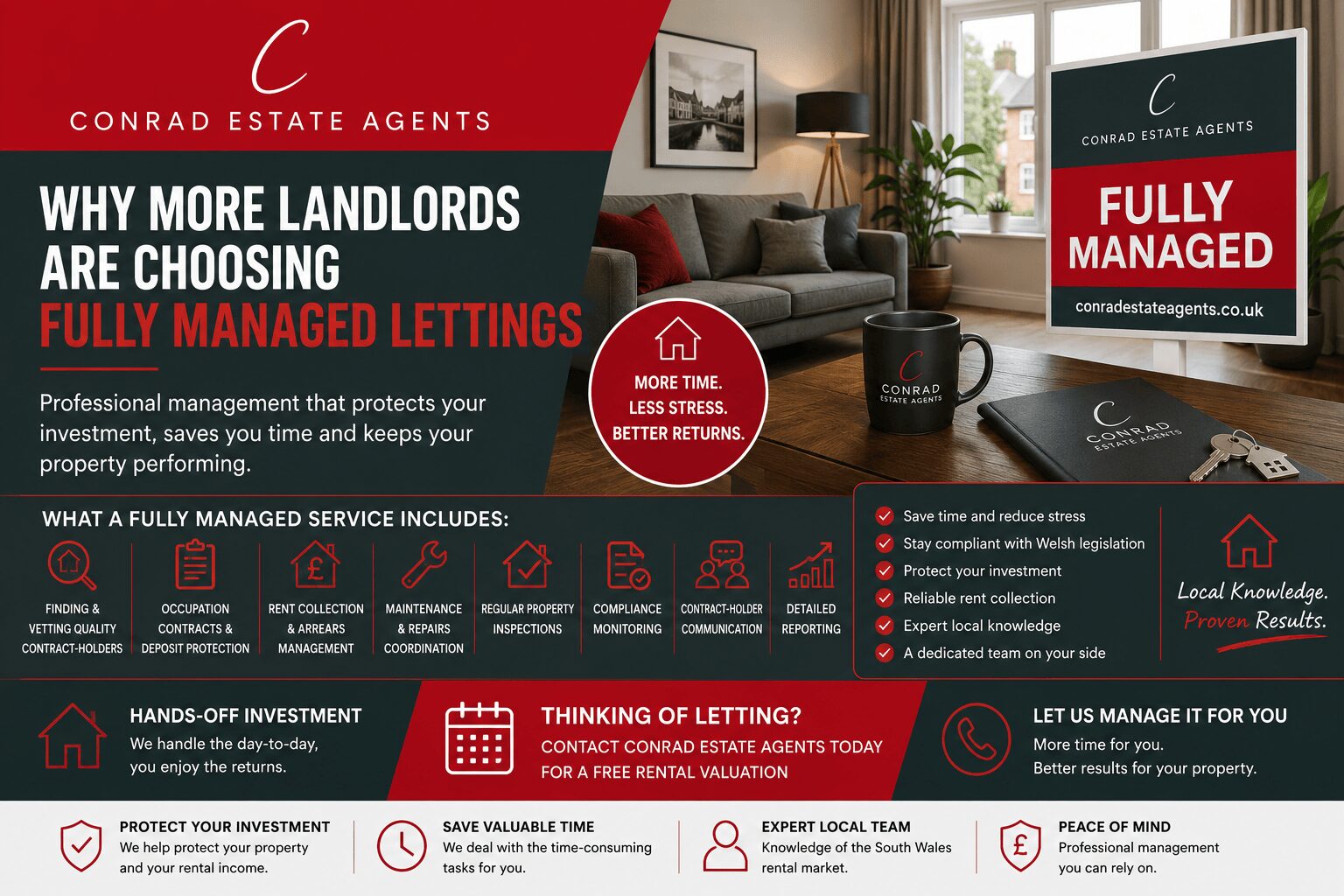
A comprehensive management service may include:
- Marketing the property
- Arranging viewings
- Applicant referencing
- Preparing occupation contracts
- Deposit administration
- Rent collection
- Contract-holder communication
- Maintenance coordination
- Property inspections
- Compliance monitoring
- Renewal administration
- Statements and landlord reporting
- Check-out coordination
The cheapest management percentage isn’t necessarily the cheapest service overall.
It’s important to understand what you’re actually receiving for the fee.
Is Fully Managed Lettings Worth It?
For some landlords, yes.
For others, self-management remains perfectly suitable.
A landlord with one property around the corner, plenty of experience and time to manage it may prefer to remain hands-on.
However, fully managed lettings can become particularly attractive if you:
- Have several properties
- Live away from your rental property
- Don’t have time to manage it
- Want help navigating Welsh legislation
- Don’t want direct day-to-day contact with the contract-holder
- Want to grow your portfolio
- Prefer a more hands-off investment
Ultimately, the question isn’t simply:
“How much does property management cost?”
It’s also:
“What is my time worth, and what risk and workload is the management fee removing?”
Fully Managed Lettings Across South Wales
At Conrad Estate Agents, we provide landlords with flexible levels of support depending on how involved they want to be.
Our services include tenant find, rent collection, and fully managed property management.
For landlords choosing full management, our aim is simple: take care of the day-to-day management while keeping you informed and in control of your investment.
Whether you own one rental property or a growing portfolio, we can discuss the level of service that best suits you.
Thinking About Changing Letting Agent?
You don’t necessarily have to wait until your property becomes vacant to change managing agent.
If your property is currently managed elsewhere and you’re unhappy with the service, communication, or level of support you’re receiving, it may be possible to transfer management of the property while the existing contract holder remains in occupation.
We can review the position and explain what’s involved before you make any decision.
Looking for a Fully Managed Letting Agent?
If you’re considering letting a property, expanding your portfolio or moving an existing rental property to professional management, speak to Conrad Estate Agents.
We’ll discuss your property, expected rental value and the management options available.
Contact Conrad Estate Agents today for a free rental valuation and to discuss our fully managed letting service.