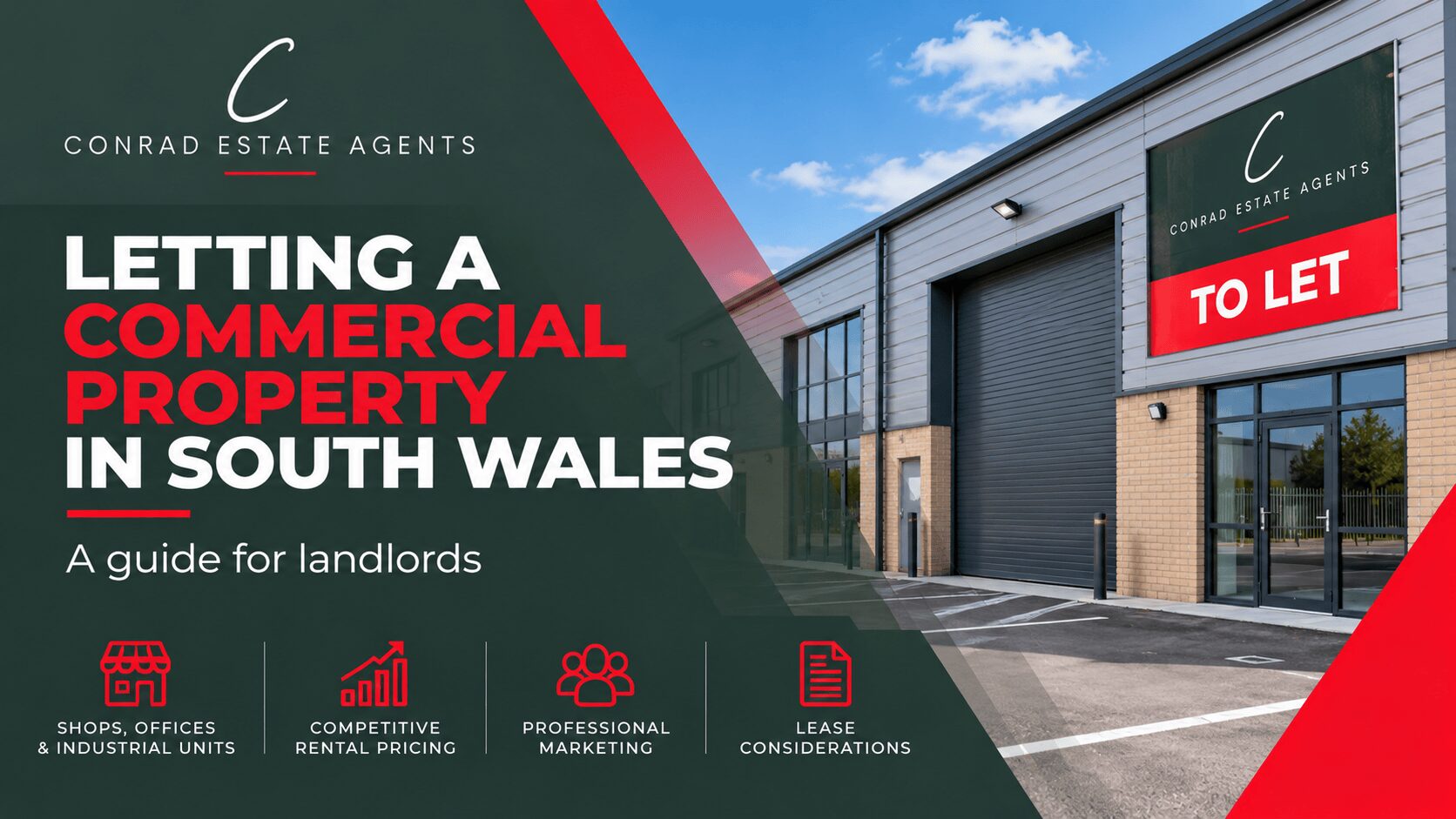
Letting a commercial property can provide an attractive source of rental income for property owners and investors. However, successfully letting a shop, office, warehouse or industrial unit involves considerably more than simply advertising the premises and finding a tenant.
From setting the right rental value to marketing the property, assessing prospective tenants, and agreeing appropriate lease terms, several key considerations come into play.
At Conrad Estate Agents, we provide commercial property sales and lettings services across Barry, the Vale of Glamorgan, Cardiff and wider South Wales.
Whether you’re letting your first commercial investment or managing an established property portfolio, understanding the commercial letting process can help protect your investment and minimise unnecessary vacant periods.
1. Understanding the Commercial Property Market
Commercial property differs significantly from residential property.
Demand depends on factors such as location, accessibility, business activity, property condition, and the premises’ suitability for specific commercial uses.
Different property types also attract different occupiers.
Retail premises: Shops and high-street units can appeal to independent retailers, service providers and other businesses seeking customer-facing premises.
Office accommodation: Offices may attract professional services, established businesses, and companies that need dedicated workspace.
Industrial units and warehouses: Industrial premises can appeal to businesses that need storage, distribution, manufacturing, or workshop space, depending on their permitted use and specifications.
Mixed-use properties: Buildings that combine commercial and residential accommodation can offer investors additional flexibility, although managing them and meeting legal requirements may be more complex.
Understanding the likely occupier is an important first step in developing an effective marketing strategy.
2. Setting the Right Commercial Rental Price
One of the most important decisions when letting commercial property is establishing a realistic market rent.
Overpricing a commercial property can lead to longer vacancies, especially when prospective occupiers have several alternative premises available.
Underpricing may reduce the property’s potential rental return.
A commercial rental assessment should consider:
- Location and surrounding commercial activity
- Property size and usable floor area
- Condition and specification
- Access and parking facilities
- Visibility and frontage
- Permitted planning use
- Comparable commercial rental evidence
- Current availability of competing premises
- Local demand for the property type
For industrial properties, additional features such as roller-shutter access, three-phase electricity, security systems, loading facilities and outside storage areas may influence demand.
The objective is to position the premises competitively while protecting the landlord’s long-term investment.
3. Minimising Commercial Property Void Periods
A vacant commercial property can become expensive.
Even when premises are unoccupied, landlords may still face ongoing costs, including insurance, maintenance, security and business rates where applicable.
Consider a commercial unit marketed at £1,000 per month.
If the property remains vacant for three months, that represents £3,000 in potential rental income lost before considering any additional holding costs.
This illustrates why securing a suitable tenant within a reasonable timeframe can sometimes be more financially beneficial than holding out indefinitely for a higher rent.
Professional marketing, realistic pricing, and responsive enquiry management can all help reduce unnecessary void periods.
4. Professional Commercial Property Marketing
First impressions matter in commercial property just as much as they do in residential sales and lettings.
Businesses need to know whether premises suit their requirements before arranging a viewing.
An effective commercial property advertisement should clearly explain the accommodation, specification and potential benefits of the premises.
This can include:
- Professional property photography
- Accurate floor areas and measurements
- Floor plans where appropriate
- Clear rental information
- Property specification and facilities
- Parking and loading arrangements
- Access and transport connections
- Relevant planning use information
- Lease terms and availability
High-quality marketing can help attract more relevant enquiries and reduce time spent arranging unsuitable viewings.
At Conrad Estate Agents, we aim to present commercial properties clearly and professionally, allowing prospective occupiers to assess their suitability.
5. Finding the Right Commercial Tenant
Securing a commercial tenant isn’t simply about finding a business willing to pay the advertised rent.
Landlords should also consider the prospective occupier’s financial position, proposed use of the premises, and ability to meet their lease obligations.
Depending on the circumstances, checks may include company information, trading history, financial references and details of the proposed business operation.
Landlords may also consider requesting a rent deposit or guarantor where appropriate.
A suitable tenant can help provide stability and reduce the risk of future payment difficulties.
6. Understanding Commercial Lease Agreements
Commercial leases are different from residential occupation contracts.
They are usually negotiated around the landlord’s, tenant’s, and property’s requirements.
Important matters may include:
Lease length: The agreed period for which the tenant will occupy the premises.
Rent reviews: Whether and how the rent may be reviewed during the lease.
Repairing obligations: Who is responsible for maintaining and repairing the property.
Insurance: How building insurance is arranged and whether costs are recoverable from the tenant.
Break clauses: Whether either party has the right to end the lease early under specified conditions.
Permitted use: The activities the tenant is allowed to undertake at the premises.
Service charges: Where applicable, contributions towards the maintenance and management of shared areas or facilities.
Commercial landlords should obtain appropriate legal advice before entering into a lease.
7. Commercial Property Compliance
Commercial landlords should also understand the legal and regulatory responsibilities associated with their premises.
Depending on the property and circumstances, these may include Energy Performance Certificate requirements, asbestos management, fire safety, electrical installations and other building-related obligations.
Responsibility for specific matters may depend on legislation, the lease terms, and how the property is occupied or controlled.
Therefore, assess a commercial property individually rather than assuming the same requirements apply to every building.
8. Should You Use a Commercial Letting Agent?
Some commercial landlords choose to market their premises independently.
However, appointing a commercial letting agent can help establish a rental value, prepare marketing materials, advertise the premises, handle enquiries, and coordinate viewings.
An agent can also help communicate proposed commercial terms and progress negotiations alongside the landlord’s solicitor and other professional advisers.
For landlords with multiple properties or those living away from their investments, this can significantly reduce the time involved in securing a new occupier.
9. Commercial Property Lettings Across South Wales
South Wales offers a broad range of commercial property opportunities, from established town-centre retail premises to offices, industrial estates, warehouses and mixed-use buildings.
At Conrad Estate Agents, we provide commercial property services across Barry, the Vale of Glamorgan, Cardiff and wider South Wales.
We work with commercial property owners who want to market vacant premises, secure suitable tenants, and make informed investment decisions.
Whether you own a small high-street shop or a larger industrial unit, our team can discuss your property and the most appropriate marketing approach.
Looking to Let Your Commercial Property?
If you own a vacant commercial property or your lease is nearing its end, now may be a good time to review your options.
Understanding the potential rental value and likely demand can help you plan your next steps.
Contact Conrad Estate Agents today to arrange a commercial rental assessment and discuss marketing your property.
Conrad Estate Agents
23 Park Crescent, Barry, CF62 6HD
Telephone: 01446 788675
Email: info@conradestateagents.co.uk
Residential Sales | Lettings | Property Management | Commercial Property