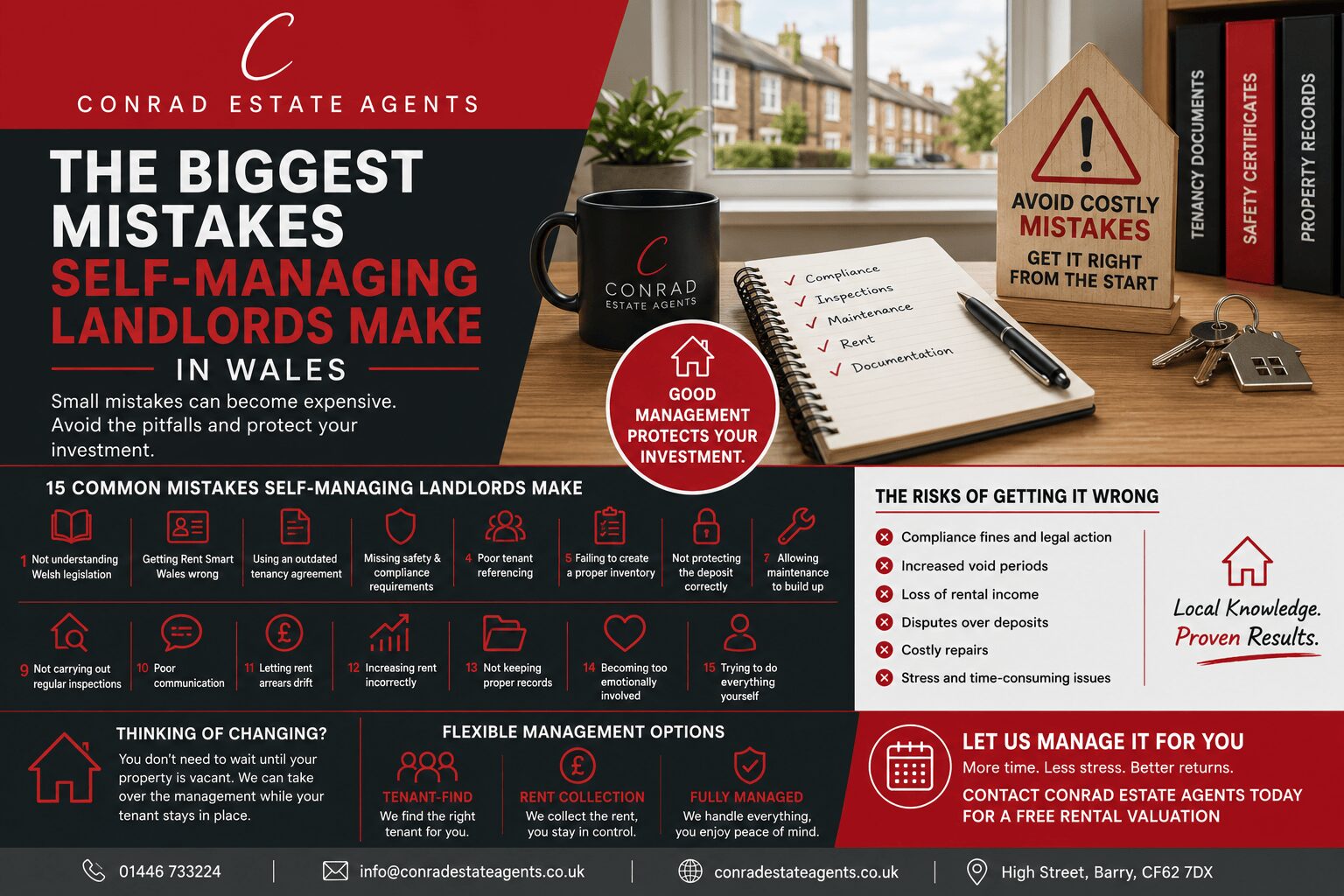
Managing your own rental property can certainly save money on letting agent fees.
For experienced landlords with the time, knowledge and systems in place, self-management can work extremely well.
However, being a landlord in Wales now involves considerably more than collecting rent and arranging the occasional repair.
From Rent Smart Wales and occupation contracts to property safety, inspections, deposits and maintenance, there are numerous responsibilities to manage throughout the life of an occupation contract.
Unfortunately, seemingly small mistakes can become expensive.
Here are some of the most common mistakes self-managing landlords should try to avoid.
1. Not Understanding Welsh Rental Legislation
One of the biggest mistakes is assuming the rules governing rental properties are the same throughout the UK.
They aren’t.
Wales has its own housing legislation, including the Renting Homes (Wales) Act 2016, and terminology and processes differ from those used in England.
For example, residential tenants in Wales are generally referred to as contract-holders, with occupation contracts replacing the traditional tenancy agreements many landlords were previously familiar with.
Using outdated information or documents intended for England can potentially create serious problems.
Landlords should ensure that the information they rely on specifically applies to properties in Wales.
2. Getting Rent Smart Wales Requirements Wrong
Landlords in Wales should understand their obligations concerning Rent Smart Wales.
Registration and licensing aren’t the same thing.
Depending on who undertakes the letting and management activities, different requirements can apply.
This is something landlords should establish before managing a property themselves, rather than discovering an issue later.
3. Using an Outdated Tenancy Agreement
Downloading an old AST template from the internet and changing the names isn’t an appropriate way to create an occupation contract in Wales.
The legal framework has changed.
The written statement provided to a contract-holder needs to reflect current Welsh legislation and the relevant type of occupation contract.
Documents should be reviewed whenever legislation changes rather than simply reusing the same template indefinitely.
4. Missing Safety and Compliance Requirements
Rental property compliance involves multiple areas.
Depending on the property, landlords may need to consider requirements relating to:
- Gas safety
- Electrical safety
- Smoke alarms
- Carbon monoxide alarms
- Energy performance
- Fitness for human habitation
- Deposit protection
- Rent Smart Wales
- Occupation contract documentation
The danger isn’t necessarily that landlords deliberately ignore these requirements.
Often, something simply expires or gets overlooked.
A certificate saved in an email inbox isn’t much use if nobody remembers when it needs to be renewed.
Good property management, therefore, requires a reliable compliance diary and document management system.
5. Poor Contract-Holder Referencing
An applicant who wants to move in quickly isn’t necessarily the best fit for the property.
Landlords understandably want to minimise void periods, but rushing referencing can create significantly greater problems later.
A thorough referencing process may consider:
- Identity
- Affordability
- Employment
- Credit history
- Previous landlord references
- Supporting documentation
- Guarantor requirements where appropriate
Referencing can’t guarantee that an occupation will be problem-free, but it provides valuable information before making an important decision.
6. Failing to Create a Proper Inventory
A few photographs on your mobile phone aren’t necessarily a comprehensive inventory.
A good inventory should provide detailed evidence of the property’s condition at the start of the occupation.
It may document:
- Walls
- Ceilings
- Flooring
- Doors
- Windows
- Kitchen
- Bathrooms
- Appliances
- Fixtures and fittings
- Furniture
- Garden
- Meter readings
- Keys provided
Photographs should support the written record.
If there’s a deposit dispute at the end of the occupation, the quality of the evidence can become extremely important.
7. Not Protecting the Deposit Correctly
If a deposit is taken, landlords need to ensure it’s dealt with in accordance with the applicable deposit protection requirements.
Simply putting the money into a separate bank account isn’t enough.
There are processes and timeframes that need to be followed.
Mistakes regarding deposits can cause problems later, including when a landlord seeks to recover possession of the property.
8. Allowing Maintenance to Build Up
A contract-holder reports a small leak.
It doesn’t look particularly serious, so the repair is postponed.
Several months later, the landlord is dealing with damaged plaster, flooring and potentially much more significant repair costs.
This is a classic example of how relatively minor maintenance can become expensive when ignored.
Good landlords don’t necessarily spend more on maintenance.
They often spend earlier.
Having reliable contractors and an organised system for dealing with repairs can help protect the property over the long term.
9. Not Carrying Out Regular Inspections
Once a good contract-holder moves in and pays the rent every month, it can be tempting to leave them alone indefinitely.
Respecting a contract-holder’s home and privacy is important.
However, that doesn’t mean landlords should never inspect their investment.
Appropriately arranged mid-term inspections can help identify:
- Maintenance requirements
- Damp and condensation
- Garden issues
- Property condition
- Potential damage
- Safety concerns
- Repairs that haven’t been reported
Inspections also create a useful documented record of the property’s condition throughout the occupation.
10. Poor Communication
Good property management requires communication.
Contract-holders should know how to report maintenance and who to contact if there’s a problem.
Likewise, landlords should keep records of important conversations and decisions.
Problems can arise when everything is handled informally through telephone calls, and there’s no written record of what was agreed.
Email and professional property-management systems can provide a much clearer audit trail.
11. Letting Rent Arrears Drift
Rent arrears rarely improve by being ignored.
If the expected rent doesn’t arrive, landlords should identify the issue promptly.
There may be a simple explanation.
However, if arrears continue, having accurate records of:
- Rent due
- Rent received
- Outstanding balances
- Communication
becomes increasingly important.
The earlier an issue is identified, the more options there may be for resolving it.
12. Increasing the Rent Incorrectly
Rental values have changed substantially in many areas, meaning some long-standing rents may be below current market levels.
However, landlords can’t simply send a message saying:
“Your rent goes up next month.”
Rent variations need to be handled correctly under the applicable Welsh legislation and occupation contract.
Before increasing rent, landlords should understand both the correct procedure and the current market value.
There’s also a commercial consideration.
Achieving the absolute maximum rent isn’t always the best long-term decision if you already have an excellent contract-holder who looks after the property and pays reliably.
13. Not Keeping Proper Records
Good record keeping is one of the less exciting parts of being a landlord, but it’s extremely important.
Landlords should maintain organised records relating to areas such as:
- Occupation contracts
- Rent payments
- Deposits
- Inspections
- Maintenance
- Contractor invoices
- Safety certificates
- Compliance documentation
- Communication
- Property expenditure
Keeping everything scattered between text messages, emails, paper folders and photographs makes management considerably harder.
14. Becoming Too Emotionally Involved
A rental property is an investment, but it may previously have been the landlord’s family home.
That can sometimes make management difficult.
A contract-holder may decorate differently, arrange furniture differently or simply live in the property differently.
Provided the property is being looked after, and the occupation contract is being followed, landlords need to distinguish between genuine property-management concerns and personal preferences.
Professional management can sometimes help create a useful separation between the landlord and the contract holder.
15. Trying to Do Everything Yourself
Saving money is important when investing in property.
But landlords should also recognise when professional assistance is worthwhile.
That doesn’t necessarily mean using a fully managed letting agent.
Depending on the landlord’s experience, they may choose professional help for:
- Referencing
- Inventories
- Compliance
- Occupation contracts
- Property inspections
- Rent collection
- Maintenance
- Accounting
- Legal matters
The key is understanding where your own knowledge ends and where specialist advice begins.
Is Self-Managing Actually Cheaper?
At first glance, the calculation looks straightforward.
If professional management costs a percentage of the rent, managing the property yourself saves that fee.
But the true calculation should also consider:
Your time + administration + compliance + contractor management + risk + void periods.
For some landlords, self-management will still be the right decision.
For others, particularly those with several properties, the time commitment alone can make professional management worthwhile.
The answer depends on your circumstances.
When Should a Landlord Consider Professional Management?
You might consider using a managing agent if:
- You don’t have time to manage the property
- You’re unsure about Welsh rental legislation
- You live away from the property
- You own several rental properties
- You don’t want direct contract-holder communication
- You’re struggling to keep track of compliance
- You want to grow your portfolio
- You simply want the investment to become more hands-off
Professional management shouldn’t remove you from important decisions.
It should remove much of the day-to-day workload while keeping you informed about your investment.
Already Have a Contract-Holder? You Can Still Consider Changing
Some landlords assume they can only appoint a managing agent when a property becomes vacant.
That isn’t necessarily the case.
If you’re currently self-managing a tenanted property and the workload is becoming difficult, it may be possible for an agent to take over ongoing management while the existing contract holder remains in occupation.
Similarly, landlords dissatisfied with their current managing agent may be able to transfer management, subject to their existing agreement and circumstances.
You don’t necessarily need to wait for the next void period to review how your property is managed.
Property Management for Landlords in Wales
At Conrad Estate Agents, we support landlords with everything from finding and referencing contract-holders through to rent collection and ongoing property management.
Our services include:
Tenant-Find – for landlords who want to manage the property themselves once a suitable contract-holder has moved in.
Rent Collection – for landlords who want assistance managing rental payments.
Fully Managed – for landlords who want us to handle the day-to-day management of the property.
Whether you own one property or a growing portfolio, we can discuss the level of support that works for you.
Contact Conrad Estate Agents today for a free rental valuation or to discuss transferring an existing rental property to our management.